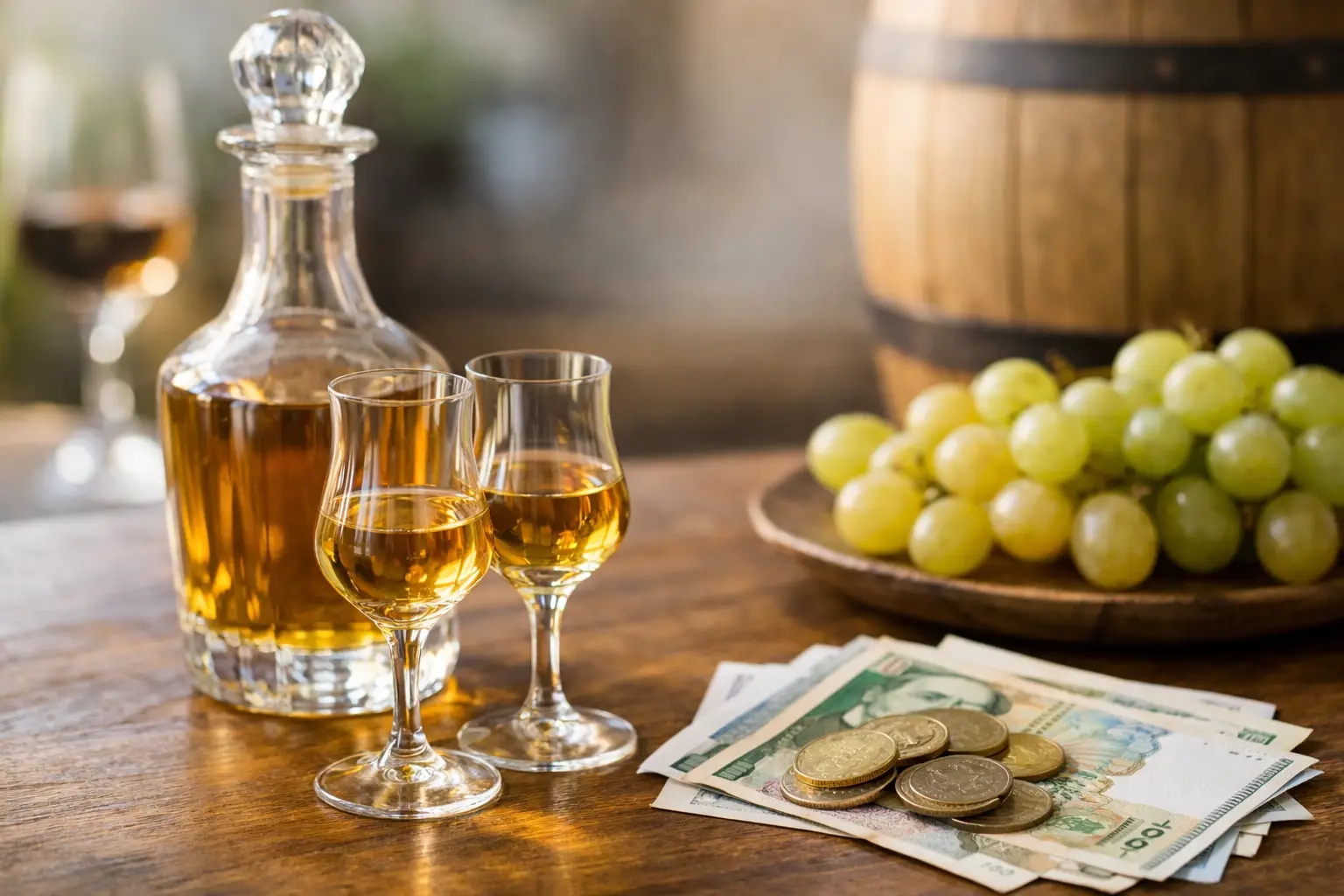
Price of Muscat Brandy—What Are You Actually Paying For?
When you search for “Muscat rakia price”, you’re not really comparing just numbers on a label. You’re comparing origin, grapes, technique, and the integrity of the producer. With this style of rakia, the difference between an ordinary drink and a memorable product is felt from the very first aroma — and that’s exactly where the price begins to make sense.
Muscat rakia is not simply a spirit with a fruity nuance. It carries the character of an aromatic grape variety, which means the raw material plays a decisive role. If the grapes are grown with care, harvested at the right moment, and processed with precision, the result is a rakia with a clean profile, softness, and a clearly expressed varietal signature. If any of these stages is compromised, the low price may seem attractive only until the first sip.
What determines the price of Muscat rakia
It all begins with the grapes. Muscat varieties are valued for their aromatic intensity, but that very quality demands precision. It’s not enough simply to have Muscat grapes. They must be healthy, properly ripe, and processed in a way that preserves their aroma. When the producer works with their own vineyard or with well‑controlled sourcing, this usually shows both in the quality and in the final price.
Next comes the technology. In rakia production, details matter — fermentation, distillation, separation of fractions, and time for rest. A cheap product often aims for volume and speed. A good Muscat rakia aims for purity and balance. This is a slower and more expensive path, but the only one that produces a spirit with character rather than just strong alcohol.
The style you are buying also matters. Some Muscat rakias are fresher and more direct, others rounder and calmer, and some rely on a more expressive aromatic profile. Depending on whether the producer aims for everyday consumption or a more premium positioning, the price changes naturally.
Low, mid, or higher price
The market often arranges rakia into three general tiers. In the lower price segment, accessibility is usually the leading factor. This does not automatically mean a bad product, but the risk of compromise is higher — unclear grape origin, less pronounced varietal character, and a rougher finish.
The mid‑range segment is where many consumers find the best balance between price and quality. Here you can already expect better production control, cleaner aroma, and a more pleasant structure. For people who want to serve a good rakia at home or give a meaningful gift without unnecessary extravagance, this is often the most reasonable choice.
The higher price segment is justified only when there are real reasons behind it. These may include grape selection, limited quantities, more careful distillation, longer resting periods, or clearly protected origin. In this tier, you are not paying only for the bottle — you are paying for work that begins in the vineyard. If the product truly carries that care, the price is not a markup but a reflection of the value invested.
How to judge whether the price is justified
A good starting point is transparency. When the producer speaks clearly about the grape variety, the region, and the production method, it’s a sign of confidence in the product. Quality Muscat rakia doesn’t need loud promises. Clear origin, consistency, and style are enough.
Look also at the description of the spirit itself. If everything is reduced to generic phrases and lacks specifics, your attention should sharpen. A good producer knows exactly what is in the bottle and is not afraid to say it. This is especially important for consumers who seek not just alcohol, but an authentic product with identity.
Price should also be viewed through the context of the occasion. For everyday use, you may look for a more accessible bottle with a reliable profile. For a gift, a special dinner, or for people who appreciate the grape variety and style, a higher price is often worth it. Not because expensive always means better, but because with a good producer the difference is genuinely felt.
Muscat rakia price and the origin of the grapes
Origin is not a marketing detail. It is the backbone of flavor. With aromatic varieties, terroir has a noticeable impact on intensity, freshness, and balance of aroma. That’s why rakia made from carefully grown grapes in a region with a clear viticultural identity has an advantage even before distillation begins.
The Black Sea region, for example, offers conditions for good ripening and preservation of the aromatic profile. When the producer works with respect for the raw material, the spirit does not lose its varietal memory. This is exactly where the difference becomes visible — between rakia that is simply correct and rakia that has character.
That is why, when looking for Muscat rakia price, it is worth asking where the grapes come from. If the answer is unclear, the low price is rarely a real advantage. If the origin is clear and supported by genuine production practice, then the price begins to make much more sense.
What you feel in the glass when the product is truly worth it
A good aroma is the first sign. In Muscat rakia it should be clean, natural, and vibrant, without intrusive sharpness. The taste should be soft but not bland. The body must carry warmth rather than roughness, and the finish should remain clear and calm.
This matters because, with this type of spirit, the aroma can easily be overwhelmed by an aggressive alcoholic profile. When that happens, the rakia loses exactly what people choose it for. If the bottle is made with precision, the varietal character doesn’t hide — it shows itself confidently, without unnecessary weight.
This is where the real difference in value lies. Well‑crafted Muscat rakia does not rely on strength, but on balance. And when balance is present, the price is no longer perceived as an expense, but as a reasonable choice.
When a lower price is a good deal — and when it isn’t
Sometimes a lower price is completely justified. This can happen with direct sales from the producer, more efficient logistics, or a cleaner market positioning without unnecessary commercial markups. In such cases, the consumer receives a good product at an honest value.
But there is also the other side. When the price is suspiciously low, there is often a shortcut somewhere — in the raw material, in technological control, or in consistency between batches. This is not always visible immediately, but it is almost always felt during consumption.
That’s why the best question is not only how much it costs, but why it costs that much. If there is a clear answer, the likelihood of making a good purchase is much higher.
How a discerning consumer makes their choice
People who seek authentic Bulgarian spirits rarely choose based only on the label. They want confidence that behind the bottle stands a real producer, not an anonymous commercial concept. They want a drink that can be placed on the table with dignity and that carries a sense of place, tradition, and honest craftsmanship.
This is exactly why Muscat rakia has its loyal audience. It is not the loudest category, but it is one of the most recognizable when made properly. It doesn’t need elaborate explanations — the glass speaks for itself.
For a producer like Izba Kaliakra, the value of such a product begins in the vineyard and passes through every stage with care for the raw material. This is the most honest answer to why one bottle costs more and another less. Not because of pretension, but because of control, origin, and character.
So next time you compare Muscat rakia price, give yourself one more moment before buying. Look for the meaning behind the number, not just the number itself. The best bottle is rarely the cheapest — but very often it is the one that leaves you with the feeling that you chose with taste and measure.
FAQ
1. What determines the price of muscat rakia?
The grape origin, raw‑material quality, fermentation and distillation technique, product style, and the producer’s integrity. “The price starts to make sense from the very first aroma.”
2. How can I tell if the price is justified?
By checking origin transparency, production details, batch consistency, and the actual sensory profile in the glass.
3. What separates low, mid, and high price tiers?
Low tier focuses on accessibility, mid tier on balance, and high tier on grape selection, limited quantities, and refined distillation.
4. Why does grape origin strongly influence price?
Because aromatic varieties express terroir vividly. The Black Sea region offers excellent ripeness and preserved aromatic intensity.
5. What do you taste when the product is truly worth it?
A clean, natural aroma, soft yet structured palate, warm body, calm finish, and balance instead of harsh alcohol.
Author: Ani Kostova